
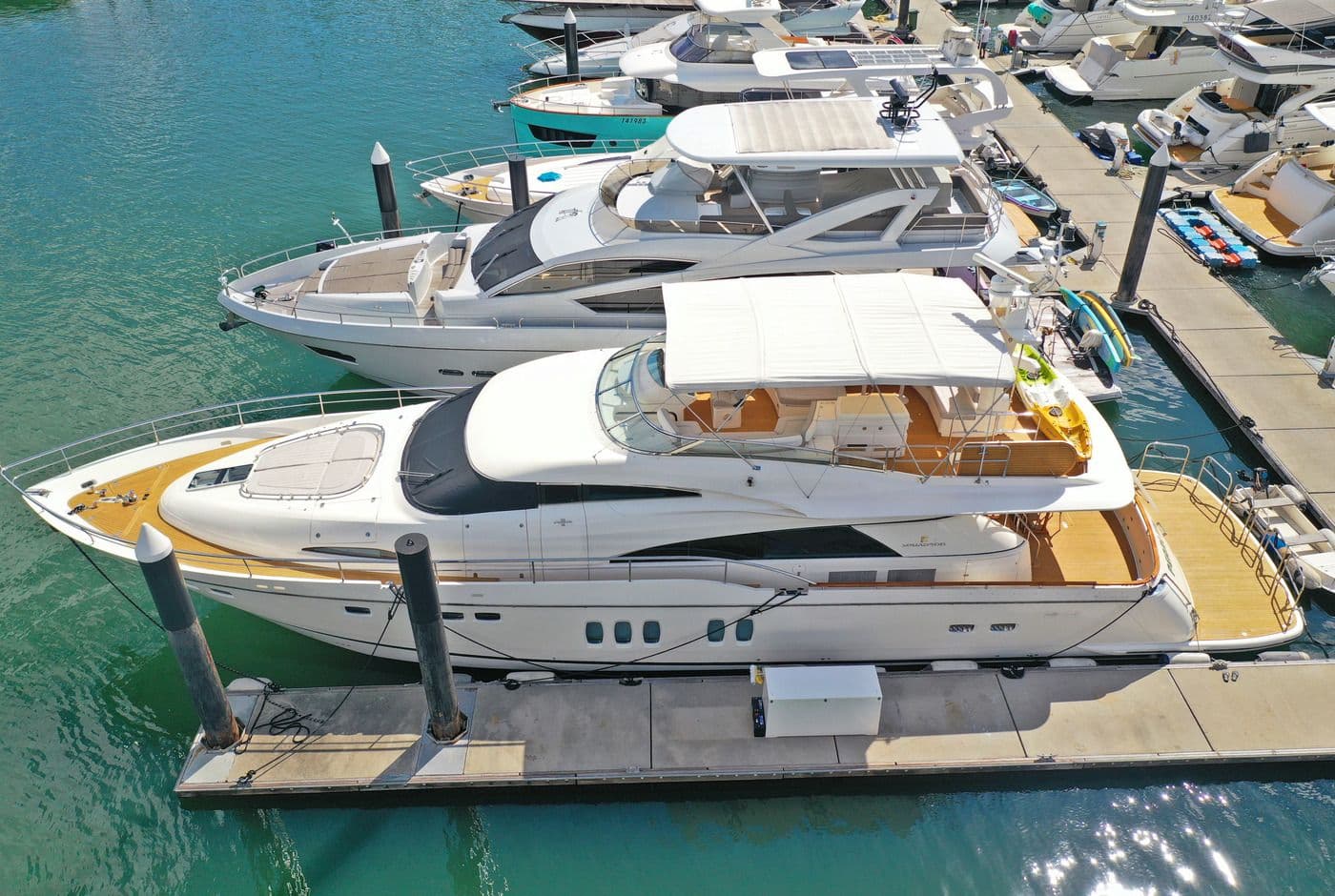
Asking PriceHK$7,500,000
Cruiser · 74.0 ft · 22.69 m · UK
2005 Fairline Squadron 74
2005· UK
Sai Kung Berthing
How hard is it to find a berth in Sai Kung? We break down Marina Cove and Hebe Haven Yacht Club, the citywide berth shortage numbers, and how to buy a yacht with the berth included.
If you want to keep a boat in Sai Kung, buyers generally have three routes: queue for a major yacht club membership and then a berth (Hebe Haven Yacht Club, for example, officially states that every berth type is full and that there is a significant waiting list in all categories, without publishing a timeframe; by comparison, the Royal Hong Kong Yacht Club (RHKYC) officially states a mooring waiting list of around five years), buy a second-hand boat that comes with a berth or a club membership attached (the industry's most common shortcut), or use a public berthing option such as a typhoon shelter or a government mooring buoy (supply is tight, and we are happy to advise on the specific waiting arrangements in the Sai Kung district). On price, taking Hebe Haven Yacht Club as an example, you must be a Senior Associate member to rent a berth: the one-off entrance fee is HK$43,400–86,800 (depending on age), the monthly fee starts at HK$1,490 (plus a monthly minimum F&B spend of $530 and a building levy of $200), and berth rental is charged separately — a marina berth costs HK$10,670 (12m) to HK$18,479 (18m) a month (HHYC Membership, HHYC Marine, as of September 2026). A Royal Hong Kong Yacht Club Debenture membership, by contrast, carries a one-off entrance fee of HK$2,180,000 (last price) — a gap of tenfold or more. In second-hand transactions that include a berth or a membership, the transfer value of the berth is usually already priced into the boat, there is no separate published rate, and the actual figure depends on the individual agreement. This structural gap is exactly why, in Sai Kung, choosing the right berthing solution matters to a buyer just as much as choosing the right boat.
The Gap · Supply vs Demand
Vessel count: info.gov.hk, LegCo question, January 2024. Berth count: HKFP, October 2025.
To understand why a Sai Kung berth is so valuable, start with the citywide numbers.
Marine Department data shows the number of licensed Class IV pleasure vessels has risen steadily over the past decade: 7,920 in 2012, 9,748 at the end of 2016, and 12,553 by 2023, up again from 11,767 in 2021 (info.gov.hk, Legislative Council question, January 2024). Total berth supply has come nowhere near keeping pace — the figure the market usually quotes is "roughly 12,500 boats versus roughly 4,300 berths" (HKFP, October 2025).
This gap did not appear overnight. A 2017 Legislative Council question (info.gov.hk) shows the government's own projections already flashing a warning: in 2017, typhoon shelter berthing demand was 544.2 hectares against a supply of 624.3 hectares, a surplus of 80.1 hectares; but by 2030, demand was forecast to rise to 629.7 hectares against a supply of only 636.4 hectares, shrinking the surplus to just 6.7 hectares. The government's conclusion at the time was that supply would be "sufficient to meet demand up to 2030".
By 2024, the official line had quietly shifted to a new formulation — "the latest assessment shows berth supply is sufficient up to 2035". What happened in between to push that deadline back by 5 years has not been explained in public records. For a prospective buyer, that shift in language is itself a signal: the official promise that "there are enough berths" gets re-examined every few years.
Hong Kong's 9 yacht clubs provide roughly 2,280 private berths across 12 locations, with essentially no vacancies and permanent waiting lists (LegCo / Marine Department paper). Of the private mooring licences issued by the Marine Department (that is, buoys laid by individuals or organisations themselves), 857 are open-ended licences issued before 2018, while new applications have been frozen since 1 January 2021 and have yet to reopen.
That supply-demand structure has bred a grey market.
A November 2023 report by Ta Kung Wen Wei Media (original article) exposed a common practice in Aberdeen Typhoon Shelter: burnt-out or written-off "dead boats" are used as fixed "buoys" to hold a typhoon shelter berth, with the space on either side quietly sublet to yachts or day-charter boats. Keeping a dead boat licensed costs only a few hundred Hong Kong dollars a year, but the berths on either side can rent for HK$20,000 to HK$32,000 a month, and as much as HK$50,000 to HK$70,000 in peak season — the trade calls it "one towing six or seven", meaning a single dead boat can tie up six or seven yachts paying rent at the same time. Every transaction is settled in cash, with no receipts and no contracts, and one month's notice is all it takes to end a tenancy. The Marine Department's response is that a vessel obstructing a fairway can be fined HK$5,000, but legislator Steven Ho has said bluntly that the government "can only respond with limited capability".
The point here is not moral judgement but a structural fact: in Hong Kong, a berth is itself a scarce asset. A licensed berth in a real location is valuable enough to sustain an underground rental market. That understanding is the key background for reading the legitimate second-hand transactions discussed below, where the boat comes with a berth — buyers pay a premium for a boat "with berth included" not out of convenience, but because the thing itself has real value.
There is movement on the supply side too, and it is worth watching. The Airport Authority plans to build the "Skytopia" yacht bay in the airport city, with phase one completed in 2028 and more than 500 berths once fully built out, around 250 of them for superyachts over 30 metres (SCMP). Aberdeen Typhoon Shelter also has a HK$20.3 billion expansion plan targeting completion by the end of 2030, providing around 200 yacht berths (Epoch Times, May 2026). But this new supply only arrives gradually from 2028 to 2031 onwards — too far off to help anyone buying today.
Want the real numbers for your case?Tell us your situation and we will go through it point by point, based on your boat and your timeline.
WhatsApp EnquiryBerthing in Hong Kong falls into roughly three systems, and they differ completely in how they work, how they charge, and whether they can be transferred.
Swipe to see the full table
| Private Yacht Club Marina | Government Private Mooring | Typhoon Shelter Public Berth | |
|---|---|---|---|
| Nature | Members-only facility run by a private club | Mooring equipment laid by an individual or organisation under a government licence | Government public waters, managed by the Marine Department |
| How to apply | Buy a membership + pay monthly fees | Apply to the Marine Department, queue under a points system | Free or low-cost public use, though the waiting list has been closed to new applications since 2021 |
| Cost | One-off entrance fees range from tens of thousands to over two million HK dollars (e.g. Hebe Haven Yacht Club Senior Associate HK$43,400–86,800; RHKYC Debenture HK$2,180,000); membership monthly fees approx. HK$2,220–2,796 (including minimum F&B / building levy), with berth/mooring rental charged separately (as of September 2026; see the table in Section 6) | Application is free; the owner pays installation and removal costs + an annual fee | Cheap in theory; in practice grey-market subletting runs HK$20,000–70,000 a month |
| Transferability | Membership can be transferred or sold under club rules | Can be legally transferred using Form MD547 | Officially cannot be sublet; large-scale illegal subletting exists |
| Current supply | 9 clubs citywide, approx. 2,280 berths, permanently full | 857 open-ended licences issued before 2018, new applications frozen | 14 typhoon shelters totalling 423 hectares, "sufficient to 2035" in theory |
| Typical examples | Royal Hong Kong Yacht Club, Aberdeen Boat Club, Lantau Boat Club | Private mooring points in Aberdeen, Sai Kung and elsewhere | 14 typhoon shelters including Aberdeen, Causeway Bay and Yau Ma Tei |
For most prospective buyers, only two routes are realistic: queue for a club and then for a berth (RHKYC officially states a mooring waiting list of around five years, and Hebe Haven Yacht Club says every berth category has a significant waiting list), or pick a second-hand boat that comes with a berth or a membership and skip the queue entirely. Which system actually applies in Sai Kung is covered in the next section. (For a side-by-side table of entrance fees and monthly fees at each club, plus a step-by-step breakdown of the transfer process, see our dedicated guide The Complete Guide to Buying a Second-Hand Yacht in Hong Kong; for annual ownership costs beyond berthing, see What Does It Really Cost to Run a Boat for a Year?.)
Sai Kung is one of Hong Kong's most concentrated yacht berthing communities, built around two locations — Marina Cove (匡湖居) and Hebe Haven Yacht Club (HHYC).
Marina Cove sits at 380 Hiram's Highway, Hebe Haven. Developed by Henderson and occupied from 1985, it is an integrated development combining a private residential estate with a marina: 6 phases, 465 blocks and 535 residential units. The marina itself offers around 360 wet berths, able to take vessels up to 100 feet, plus dockside storage for speedboats and runabouts and a hardstand for routine maintenance. Clubhouse facilities are comprehensive, including Chinese and Western restaurants, a residents' clubhouse, swimming pool, gym, shopping centre and tennis courts (sources: Centaline, marinacove.org.hk).
The Sun Yachts office is on the ground floor of Marina Cove Shopping Centre, which means this marina community is the berthing environment we know best day to day. Do note, though, that Marina Cove is a private residential estate with a marina rather than a standalone commercial yacht club — how exactly berths are tied to the property (townhouse or unit), whether a transfer requires approval from the owners' incorporation, and whether there is an open market price are all practical operational details. We would be glad to discuss them with you directly.
Hebe Haven Yacht Club sits in a natural harbour in the middle of the Sai Kung peninsula, sheltered on three sides by land. It offers 53 dedicated walk-on-walk-off berths for vessels from 12 to 18 metres, all with power and water. The club's membership structure is clearly tiered (Cadet, Junior, Associate I/II), but every berth type at present — marina berth, swing mooring, hardstand and racking — is full, with a significant waiting list in every category; the club does not publish a timeframe (HHYC Membership, as of September 2026). Note that the club states Associate, Junior and Cadet members cannot rent a marina berth, swing mooring or hardstand space — renting a berth requires Senior Associate membership (one-off entrance fee HK$43,400–86,800 depending on age; monthly fee HK$1,490). The club's website also notes that its PRL (Private Recreational Lease) is due for renewal in 2027, and states that entrance fees will not be refunded. The club also states plainly that it does not accept membership applications with a commercial element.
That waiting list, measured in years, is precisely why "membership included" has become a genuine selling point in the second-hand market in Sai Kung and across Hong Kong. A buyer starting from scratch should expect to wait many years; buying a boat where the membership transfers with it can, in principle, skip that queue entirely (the transfer itself still needs club approval — see the next section for details).
"Berthing arrangements" is one of Sun Yachts' four core services, alongside sales, charter and brokerage. In practice, "membership or berth transferred together with the boat" is a common structure in our inventory. Here are a few real examples:
The commercial logic is straightforward: the seller transfers their yacht club membership or berth to the buyer along with the boat, and the buyer skips the most painful step of all — waiting for a membership. The seller benefits too, because a boat that comes with a berth holds its asking price rather than being discounted as "just a hull". Whether a membership transfer actually requires case-by-case club approval, whether a berth follows the person or the boat (that is, whether it lapses automatically on a change of owner), and what administrative steps a transfer involves are all internal club rules, and different clubs may handle them differently. We would be glad to discuss the details with you directly.
For a prospective buyer, this structure points to a practical strategy: rather than treating "buying a boat" and "finding a berth" as two separate problems, look first at inventory boats that already come with a berth or a membership — one transaction solves both, and it sidesteps the shortage described above.
Want the real numbers for your case?Tell us your situation and we will go through it point by point, based on your boat and your timeline.
WhatsApp EnquiryIn stock · sold with membership or berth
2005· UK
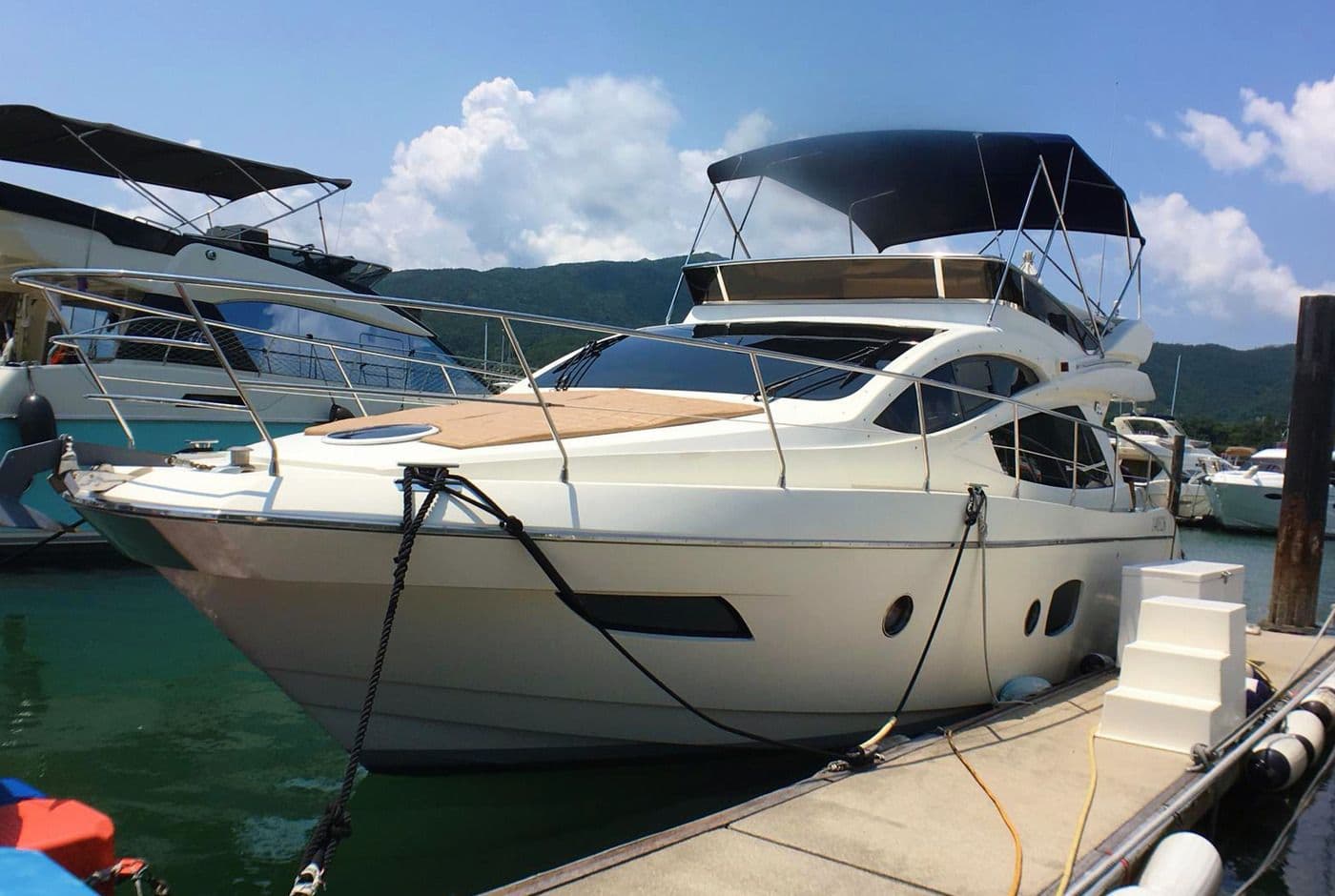
2011· Spain
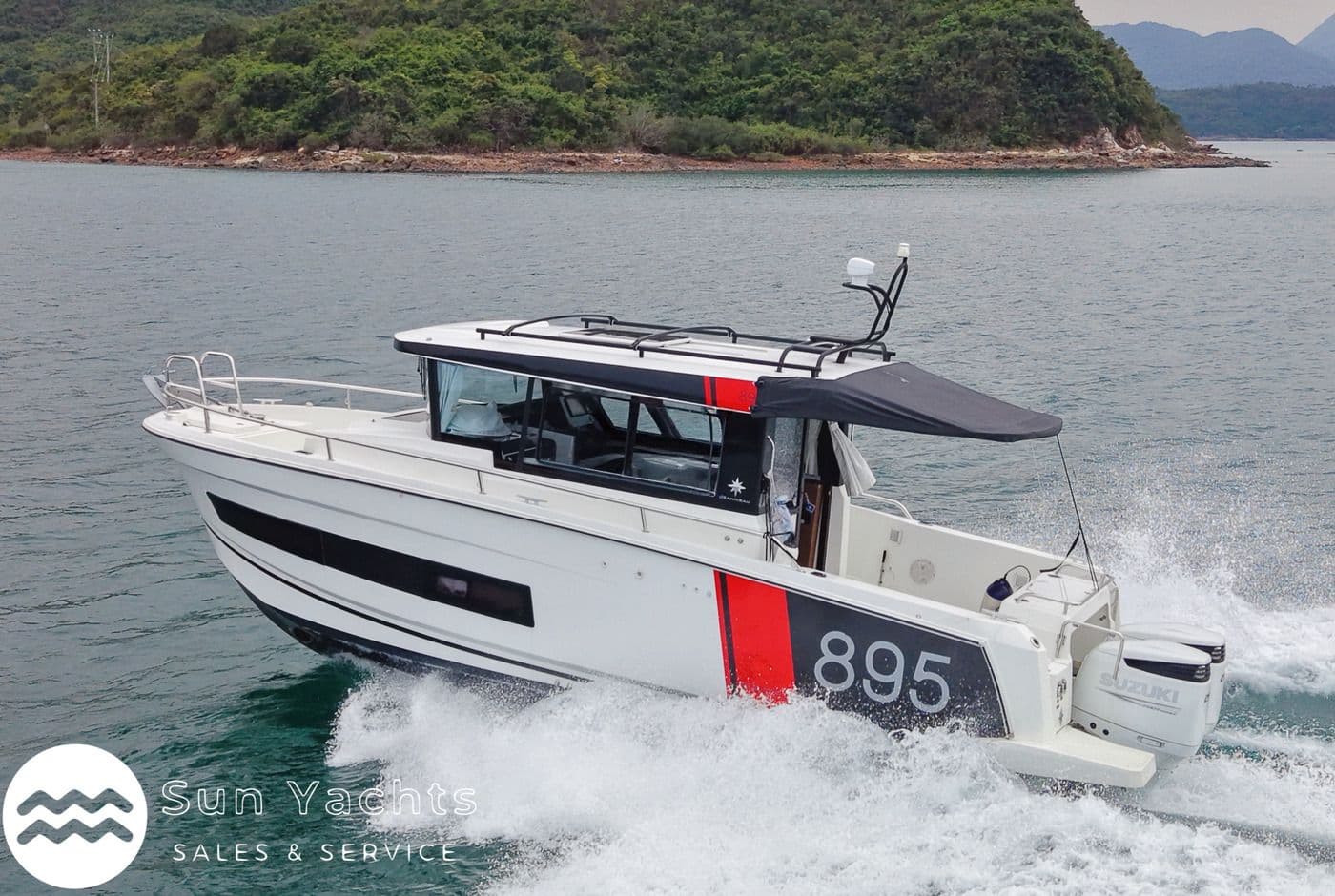
2022· France
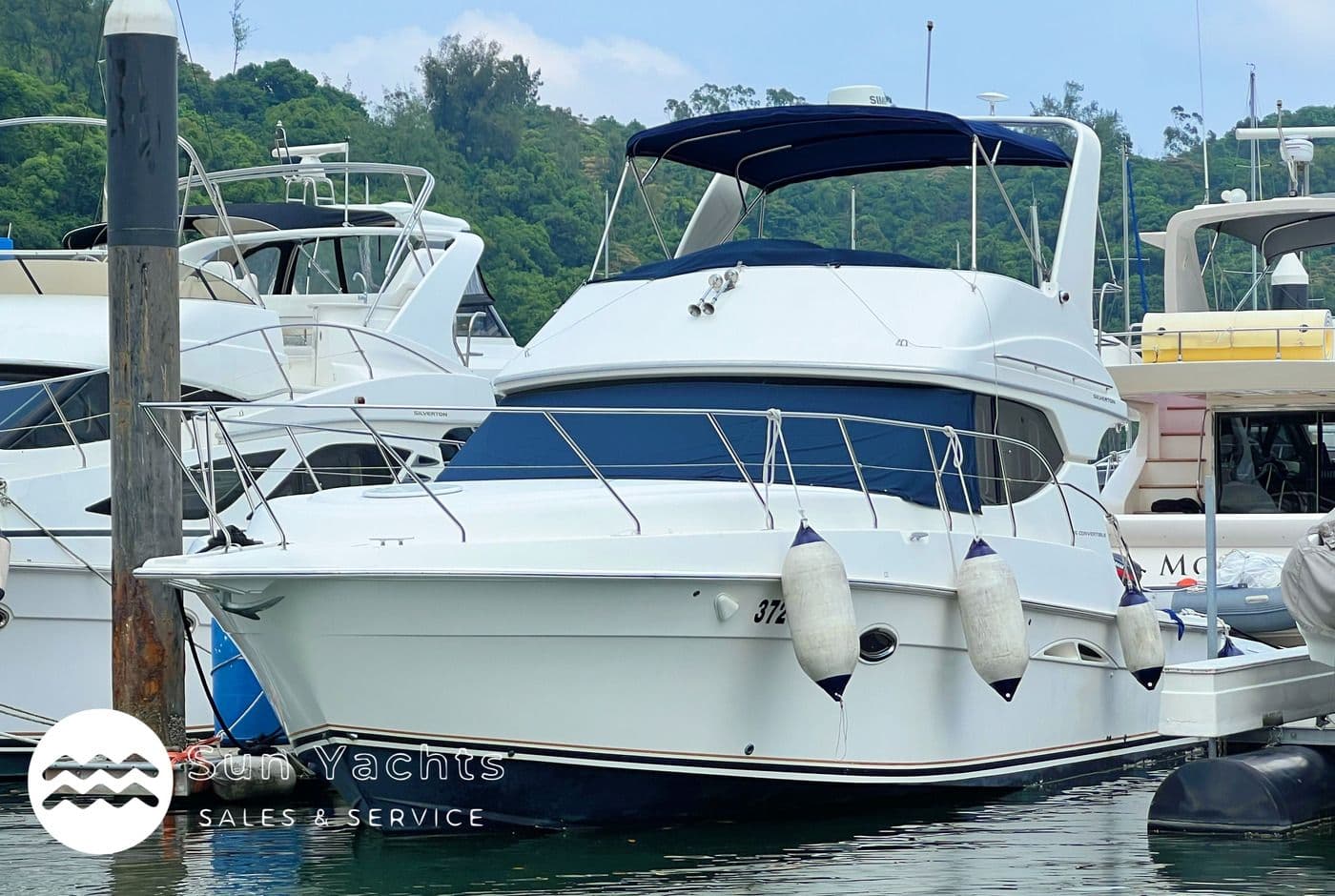
2004· USA
Beyond the concentration of berthing facilities, the water itself is a reason buyers base themselves here. The Sai Kung peninsula has Hong Kong's longest coastline and the greatest number of outlying islands, with hills, country parks, uninhabited islands, white sand beaches, cliffs and sea-eroded landforms all within reach. The area is also the Sai Kung Volcanic Rock Region of the Hong Kong UNESCO Global Geopark, which joined the Global Geoparks Network in 2011 (HKTB).
Famous geological features include the hexagonal volcanic rock columns at Po Pin Chau, the "pineapple bun rock" and tombolo at Sharp Island, and the bell-shaped arch at the southern tip of High Island. A typical two-hour cruise already covers multiple geological wonders across Sharp Island, High Island and Basalt Island, and arriving by sea is by far the best way to appreciate them. Put another way, Sai Kung is one of the rare places in Hong Kong where you can step aboard in the morning and tour the entire geopark in two hours — and that geographic advantage is what explains the concentration of yacht clubs and private berth demand in this stretch of water.
After the Sai Kung deep-dive, many buyers ask: if not Sai Kung, what are the other options — and which is cheaper or easier to get into? The table below pulls together public data across 9 rows of major clubs/marinas (RHKYC split into two rows) for a side-by-side comparison. Principle: any figure without a public source is marked "enquiry required" — no estimates are used as a substitute; third-party membership broker quotes are labelled as such, never treated as official.
Swipe to see the full table
| Club / Marina | Location | Berth type | Membership requirement | Public reference fee | Waiting list |
|---|---|---|---|---|---|
| Marina Cove | Hiram's Highway, Sai Kung | ~360 wet pontoon berths (up to 100ft) + dockside storage + hardstand | Private estate with attached marina; the exact link between berth ownership and property (townhouse/unit) is not published — we are checking with Sun Yachts management | Enquiry required — no published monthly fee schedule (Marina Cove official site, checked September 2026) | No public data available — we are checking |
| Hebe Haven Yacht Club (HHYC) | Pak Sha Wan, Sai Kung | 53 walk-on-walk-off dedicated berths, 12–18m | Tiered membership (Cadet / Junior / Associate I/II / Senior Associate / Corporate); only Senior Associates (or Corporate nominees) may rent a berth | One-off entrance fee HK$43,400–86,800 (Senior Associate, by age; the tier required to rent a berth); monthly fee HK$1,490 + monthly minimum F&B $530 + building levy $200; berths charged separately: marina berth $10,670 (12m)–$18,479 (18m) a month, swing mooring $1,757–4,118 (HHYC Membership, HHYC Marine, accessed September 2026) | No timeframe published — all berth types (marina berth, swing mooring, hardstand, racking) are full, with a significant waiting list in every category (HHYC Membership) |
| Royal Hong Kong Yacht Club (RHKYC) — Shelter Cove (off Sai Kung) | Sai Kung / Clear Water Bay peninsula, near Pak Sha Wan | Marina berth (46 berths, 10–27m, walk-on) + swing mooring (150 moorings) | Debenture membership | Debenture entrance fee HK$2,180,000 (last price); monthly (subscription + building levy + minimum F&B) approx. HK$2,796 combined; berth/mooring fees charged separately by LOA, HK$2,640–3,900 (RHKYC Membership page, RHKYC Marine Fees, effective 1 August 2026) | Approx. 5 years — all sizes of berths/moorings are full (RHKYC Shelter Cove Marina official page) |
| RHKYC — Kellett Island (Causeway Bay) / Middle Island (Deep Water Bay) | Causeway Bay / Deep Water Bay | Hardstand (small sailing classes) + swing mooring (up to 28m by LOA) | Same Debenture membership, valid across all three clubhouses | Mooring fees by LOA: Causeway Bay HK$4,040–10,180, Middle Island HK$2,485–2,670 (RHKYC Marine Fees, effective 1 August 2026) | Not broken out by location on the official site; only a general "approx. 5 years, all locations and sizes" is stated |
| Aberdeen Boat Club (ABC) | Shum Wan Road, Aberdeen | Hardstand / mooring (details not published) | Tiered: Debenture / Nominee / Ordinary / Associate | Debenture entrance fee HK$1,380,000; monthly fee listed on the official site as "$1,720 x 4", exact billing structure unclear — confirm with the club directly (ABC Membership page) | No public timeframe published; the site only notes the Young Associate tier is "quota full" |
| Aberdeen Typhoon Shelter (public) | Aberdeen | Public typhoon shelter anchorage (government waters, no club) | Nominally membership-free; new applications frozen since 1 January 2021, not yet reopened | Nominally low cost; actual grey-market sublet rents reach HK$20,000–70,000 a month (Ta Kung Wen Wei, November 2023) | New applications frozen, no official reopening timeline |
| Clearwater Bay Marina Club | Tai Au Mun, Clear Water Bay, Sai Kung | Wet berth (berth count / maximum size not published — enquiry required) | Individual / Corporate membership | Individual entrance approx. HK$1,300,000 + monthly approx. HK$2,810; Corporate approx. HK$1,950,000 + monthly approx. HK$2,990 (third-party membership broker quote, not an official publication, amigomembership.com, for reference only) | No public data available |
| Gold Coast Yacht & Country Club | Gold Coast, Tuen Mun | Wet berth / dry berth | Individual / Corporate, split into Country Club and Yacht Club tiers | Individual Yacht Club wet berth approx. HK$431,000, dry berth approx. HK$359,000 (third-party membership broker quote, not an official publication, sakura-membership.com, for reference only); monthly fee: enquiry required | No public data available |
| Discovery Bay Marina | Discovery Bay | Private estate with attached marina (similar model to Marina Cove) | Enquiry required | Enquiry required — no official published fee page found | No public data available |
How to read this table: the RHKYC, HHYC and ABC rows come from each club's own official site and carry the highest confidence; the Clearwater Bay and Gold Coast rows come from third-party membership broker sites, not official club publications — actual entrance fees will vary by batch, market conditions and resale timing, so buyers should confirm directly with the club or broker before committing. "Private estate with attached marina" models like Marina Cove and Discovery Bay typically don't publish a fee schedule at all — access runs through industry relationships, which is exactly the gap Sun Yachts' berthing service exists to fill.
The table above reveals a pattern that goes beyond HHYC alone: even the internationally established RHKYC reports its Sai Kung Shelter Cove berths and moorings as "full across all sizes, waiting list of approximately 5 years" (RHKYC official). This isn't one club's isolated problem — it's structural, for three reasons:
Where does Marina Cove stand? Marina Cove operates as a private residential estate with an attached marina, and unlike RHKYC or HHYC it does not run a publicly disclosed "waiting list" system — details on berth supply, the transfer mechanism, and whether ownership must be tied to a property are not published on its official site. We are following up with Sun Yachts management to confirm the current situation and whether any spots exist through industry channels. Until an official answer is available, the practical approach for a serious buyer is: rather than wait on a list of unknown length, look directly at second-hand boats that already come with a berth or membership attached (see Section 4), or contact Sun Yachts' berthing service directly to check current availability.
Want the real numbers for your case?Tell us your situation and we will go through it point by point, based on your boat and your timeline.
WhatsApp EnquiryFAQ — Common Questions
Talk To Us
Want to see which boats in stock come with a club membership or a berth? Tell us the type and length you are after and we will match you.
Sources