Engines · Diesel, Petrol, Outboard

Diesel vs Petrol vs Outboard: Yacht Engines in Hong Kong

Diesel, petrol sterndrive or outboard? We sorted the engines on all 65 boats we list by count, length and asking price, then compare upkeep, fuel and fire risk.

2026.10.27Sun Yachts

The short answer: every powerboat of 40 ft or more in our stock has inboard diesel engines. Under 30 ft, used for short trips, outboards or petrol (gas) sterndrives are more common. Of the 65 boats we list, 49 (about three quarters) are inboard diesel, 4 are outboard, and only 3 are clearly stated as inboard petrol or sterndrive. This article covers engine type only, not engine hours (see how to read engine hours).

Want the real numbers for your case?Tell us your situation and we will go through it point by point, based on your boat and your timeline.

WhatsApp Enquiry
01

The overview: engine types in our current stock

Everything below is Sun Yachts stock as of 27 Oct 2026, taken from the engine field of our listings. All 65 boats are for sale. We classify only from what the engine field says; if it isn't clear, we don't guess, and the boat goes under "Unclassified" (method in the next section). Length comes from the length field, converted to feet. One boat is an extreme case (far longer than the rest of the stock), so it is left out of the length figures but still counted in numbers and asking prices. Boats at "Price on request" are counted but left out of price ranges and medians.

Swipe to see the full table

Engine typeBoatsLength (ft): range / medianAsking price (HK$): range / medianPriced boats
Inboard diesel (incl. IPS / shaft drive)4921–116 / about 48.5 (excl. the extreme case)368,000–42,800,000 / 3,440,00046 (3 on request)
Inboard petrol / sterndrive322–32.5 / about 24450,000–930,000 / 880,0003
Outboard427–38 / about 29590,000–1,380,000 / 974,0004
Unclassified619.5–36.5 / about 30420,000–1,500,000 / 1,225,0006
Sailboats (counted separately; 2 list a Yanmar auxiliary diesel, the Oceanis 48 has a blank engine field)340–48 / about 451,280,000–2,380,000 / 1,380,0003

Three things to keep in mind:

  • Petrol and outboard each have only 3–4 boats. This is how our stock is spread, not a market statistic.
  • The diesel row includes 3 boats at "Price on request" (Ruby 80, Princess Y85, Bavaria Virtess 420 Fly). They count towards the 49 but not towards price figures.
  • The diesel length range runs from 21 ft (Ranger Tugs R-21) to 116 ft (2013 Azimut Grande120 SL). Extremes stretch a range, so the median tells you more.

To see what a given budget buys, browse boats at HK$1–3 million or over HK$6 million and check the engine field using the method below. For overall asking-price levels, see the Hong Kong used yacht price guide.

02

How we classified the boats (and what we couldn't)

We use only the text of the engine field (for sailboats we also look at boat type and name). The rules are simple:

  1. Sailboats counted separately: the boat type field is Sailboat, or the name is a Beneteau Oceanis (3 boats).
  2. Outboard: the engine field says Outboard. Example: the 2017 Axopar 37 Sport Cabin lists "2 x Mercury Petrol Outboard 350HP".
  3. Inboard petrol / sterndrive: the field says Petrol, or the engine is a gasoline direct injection (GDI) unit. Example: the 2008 Crownline 315 SCR lists "2 x Mercruiser Petrol". The MasterCraft NXT22 and NXT24 use ILMOR GDI engines.
  4. Inboard diesel: the field says Diesel (27 of the 49), or the brand only makes marine diesels at this power level (MAN, MTU, Caterpillar / CAT, Cummins, Yanmar), or the field names a Volvo diesel series (D-series, IPS). 22 boats are classed by brand or model this way. Example: the 2015 Prestige 450 lists "2 x VOLVO IPS600 440Hp", with no word "Diesel". Volvo Penta also makes petrol engines (V6 and V8 ranges), and two boats (the 2014 Absolute 45 Fly and 2013 Cranchi M38) list only a horsepower figure, so we class them as diesel on the usual factory fit; check the engine plate before you buy.
  5. Unclassified: 6 boats. The 2010 Carver 360 Sport Sedan lists "2x MerCruiser 375Hp"; MerCruiser makes both petrol and diesel, so the text can't tell. The 2021 Saxdor 200 lists "1 x Mercury 150HP" without saying outboard or inboard.

One limit to be upfront about: among the 22 classed by brand or model, an individual exception is possible. The only sure answer is the engine plate in the engine room before you buy.

03

Inboard diesel: the mainstream in Hong Kong's used market

The 49 diesel boats cover the whole price range. By length (the extreme case excluded, so the four groups total 48):

Swipe to see the full table

Length (ft)BoatsAsking price (HK$)Median (HK$)
Under 4011368,000–4,280,0001,380,000
40–5018 (1 on request)980,000–8,800,0003,980,000
50–6591,200,000–8,200,0003,200,000
65 and over10 (2 on request)3,000,000–42,800,0008,390,000

The pattern is clear: the bigger the boat, the more diesel is the only option. Every powerboat of 40 ft or more in stock has inboard diesel. All 29 priced boats asking HK$3 million or more, plus the 3 at "Price on request", are diesel. Small boats can be diesel too: the 2016 Tullio Abbate Elite 27 ("Inboard Mercruiser Diesel 370Hp", HK$480,000) and the 2014 Ranger Tugs R-21 ("1 x VOLVO D1 30Hp", HK$368,000).

Single or twin engine?

Five diesel boats in stock are single-engine (the field starts "1 x"), for example the 2019 SELENE 42 STATUS PANEL ("1 x CUMMINS DIESEL 380HP", HK$3,380,000). 42 are twin-engine, 1 has three engines (the 2013 Azimut Grande120 SL), and 1 doesn't state a number. With twins, if one fails you can still limp home on the other, and handling is sharper. A single is cheaper to service and fuel, but a failure means a tow. The right choice depends on how far you go.

How diesel boats are described: shaft drive, IPS, Volvo D

  • Shaft drive: the traditional layout, where the engine turns the propeller through a shaft. An advert may say "shaft drive" or simply name the engine.
  • Volvo IPS: diesel engines driving propeller pods under the hull. Five boats in stock say IPS in the engine field, such as the 2015 Prestige 450 (HK$3,980,000). In a 2005 Volvo test, a Cranchi 41 with two 370 hp engines cruising at 30 knots burned about 95 litres an hour with IPS against about 135 with shaft drive, roughly 30% less (source). That is the manufacturer's own single test, not a promise for your boat. Pod drives are also a different structure from a traditional shaft, so make sure the surveyor inspects them properly at haul-out.
  • Volvo D series: for example the 2018 Sealine F380 ("2 x VOLVO D6 330Hp", HK$3,280,000).

Trade-offs of diesel

  • Safety: petrol and petrol vapour ignite far more easily than diesel, so engine-room fire risk is generally considered lower with diesel. Diesel is still flammable and the same safety rules apply (Power & Motoryacht). This matters to owners who keep a boat in hot weather for long periods.
  • Life and durability: an article reproduced by Boattest from Discover Boating says marine petrol engines average roughly 1,500 hours to overhaul and diesels roughly 5,000 (source). These are industry averages. Service history and use matter more than any average.
  • Maintenance: parts are bigger and heavier, so each service usually costs more than on a small petrol engine. Watch for water in the fuel tank: free water settles at the bottom, and microbes grow at the water-fuel boundary, faster in warm weather (Donaldson technical article). Hong Kong is warm and humid for much of the year, so draining and regular fuel checks matter more here (that is our inference; the article is not specific to Hong Kong).
  • Fuel use: at the same power, diesel generally burns less than petrol, but the gap changes with speed, load and engine, and there is no agreed figure. For a specific engine, check the maker's fuel-consumption curve, for example in the Volvo Penta D6-330 datasheet.
  • Downsides: usually dearer to buy, heavier, and less "snappy" off the mark than petrol.
04

Inboard petrol and sterndrive: the small-boat, short-trip choice

Three boats in stock are clearly petrol, all 32.5 ft or under, asking HK$450,000–930,000:

Swipe to see the full table

BoatEngine (as listed)Asking price (HK$)
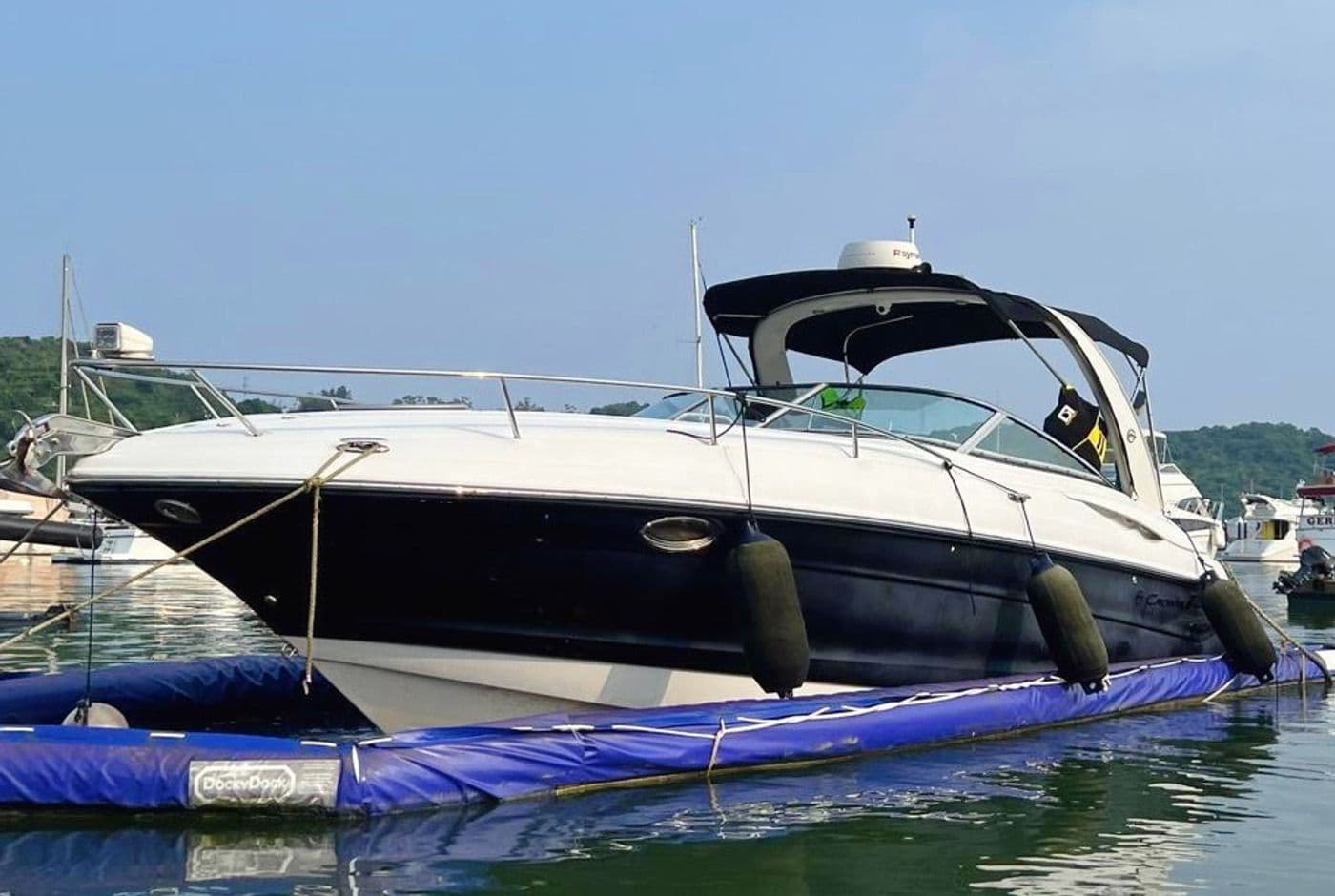
2008 Crownline 315 SCR2 x Mercruiser Petrol450,000
2022 MasterCraft NXT22ILMOR 5.3L GDI VD 1.75 365HP880,000
2022 MasterCraft NXT24ILMOR 6.2 L GDI VD 1.57 430HP930,000

MasterCraft builds dedicated waterski and wake boats where acceleration and wake shape are the selling points, hence the petrol engines: quick off the line, quieter, lighter.

Trade-offs of petrol:

  • Purchase and overhaul cost: petrol engines are generally lighter and simpler, and usually cost less to buy than a diesel of similar size. This is most noticeable on small boats that aren't used much. The gap depends on brand and model, and we couldn't find a reliable public comparison, so we give no figure.
  • Fuel use: higher at the same power, but on a small boat used for short trips the absolute cost is modest. It shows up if you go offshore often.
  • Safety: petrol vapour is heavier than air and settles in the bilge. BoatUS Foundation guidance says vapour is heavier than air and spreads through enclosed spaces, so open the hatch and run the blower for at least four minutes before starting, then check the bilge and enclosed areas for fuel smell (source). That is US guidance, not Hong Kong law. When buying second-hand, check the blower works, fuel lines aren't perished, and there are no leak marks. Ask the seller whether a vapour detector is fitted, but treat it as a bonus rather than something you should expect.
  • Corrosion: a sterndrive leg sits in seawater, so the rubber bellows and anodes are routine inspection items; how often to inspect or replace them depends on your drive's manual. Water quality and corrosion rates may differ between a typhoon shelter and open water, so ask your surveyor to look at this specifically.
05

Outboards: only 4 in stock, suited to small and mid-size fast boats

Four outboard boats, 27–38 ft, asking HK$590,000–1,380,000:

Swipe to see the full table

BoatEngine (as listed)Asking price (HK$)
2015 Starfisher 830 OBS Cabin1 x Outboard Mercury 300HP590,000
2017 Axopar 28 Cabin1 x EVINRUDE PETROL OUTBOARD 300HP598,000
2017 Axopar 37 Sport Cabin2 x Mercury Petrol Outboard 350HP1,350,000

Three are listed above; the fourth (twin Suzuki outboards) is counted in the totals and price range.

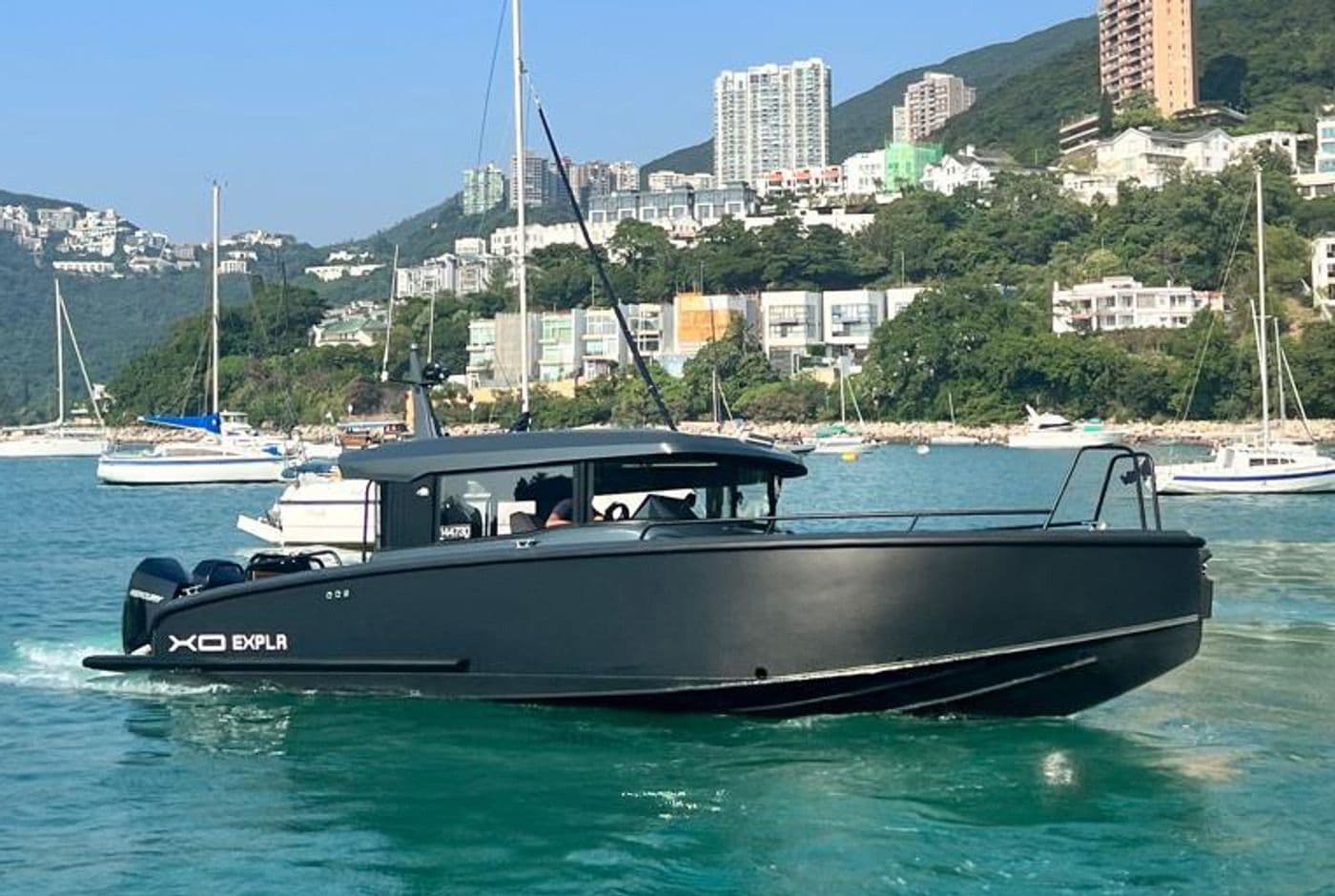
The 2021 Saxdor 200 ("1 x Mercury 150HP", HK$420,000) and 2023 XO EXPLR 10 Sport ("2 x 250HP Mercury V8", HK$1,500,000) don't say outboard in the engine field, so they sit under "Unclassified". Boats of that type commonly use outboards.

Trade-offs of outboards:

  • Easiest to service: the engine is outside on the transom, so repair or replacement doesn't mean opening up the engine room, and the engine can be lifted off and taken to a workshop. How long a job takes depends on parts and workshop schedules; there is no general answer.
  • More interior space: no engine room, so the space can become storage or a cabin, which is a real gain on a small boat.
  • Safety: the fuel tank is still inside the hull, so vapour remains a consideration, but the engine itself is out in the open air.
  • Downsides: the exposed engine is more open to sea corrosion and theft, and heavy outboards can make the stern sit low if they are too large.
  • Big boats use them too: it used to be said that outboards suit only small boats; that is changing. When Mercury launched the 600 hp V12 Verado, it said it expected to take outboard power onto boats over 60 ft (Soundings), with several engines mounted side by side. But the largest outboard boat in our stock is 37.89 ft (Axopar 37 Sport Cabin), and buyers of larger boats still mostly go for inboard diesel.
  • Discontinued brand: the Evinrude on the Axopar 28 is a discontinued make. BRP announced in May 2020 that it would stop Evinrude production while continuing parts supply and warranty service for existing owners (Chesapeake Bay Magazine). Whether a local Hong Kong dealer still has stock is something to ask before buying.
06

The three types side by side: upkeep and fuel

Swipe to see the full table

Inboard dieselInboard petrol / sterndriveOutboard
Purchase price (same size)Usually higherUsually lowerDepends on power and brand
Fuel use (same power)Generally lowestGenerally higherDepends on hull and speed
ServicingEngine room, needs a technicianEngine room, plus the drive legSimplest; can be lifted off and sent to a workshop
Fire / explosion riskLower, but still flammableHigher; needs ventilationEngine in open air; fuel tank still needs care
Length in our stock21–116 ft22–32.5 ft27–38 ft

(The length row shows what we have in stock, not a rule or a limit.)

Engine type is tied closely to how you use the boat. If you head out from Sai Kung every weekend to open water and other districts, twin diesels are the steady choice. If you mostly make short trips around a typhoon shelter 20 or 30 times a year, a petrol sterndrive or an outboard may cost less to own overall. For the wider picture of running costs (berth, insurance, maintenance), see what it costs to own a yacht in Hong Kong.

07

What to add to the survey for each engine type

For the full survey process, see the complete guide to buying a second-hand yacht in Hong Kong and the pre-purchase yacht survey. By engine type, ask the surveyor to look at:

  • Diesel: fuel filters, water in the tank, exhaust colour, turbochargers, engine mounts. For IPS, the pod seals and anodes.
  • Petrol sterndrive: engine-room fuel lines, blower, drive-leg rubber bellows, anodes, water-pump impeller.
  • Outboard: a compression test on each engine, water pump, gear oil (any water in it), and any corrosion or cracking in the transom.
08

How to choose in three steps

  1. Budget and length. In our stock, 10 boats are priced under HK$1 million: 3 petrol, 2 outboard, 3 diesel (for example the 2016 Tullio Abbate Elite 27) and 2 unclassified, mostly 20–35 ft. At HK$3 million or more, every boat is inboard diesel.
  2. How often, and how far. For short trips, the fuel-cost difference is small in absolute terms, so purchase price and ease of servicing matter most. For long runs or crossing districts, fuel use, range and reliability drive the cost.
  3. Who will look after it. An outboard can be taken to a shop; an inboard needs a technician in the engine room. Before you decide, check there is a reliable technician near your berth, and how long parts take to arrive for that brand.

For the same budget and the same length, engine type often rules out half the choices. Decide on the engine first, then look at models.

Want the real numbers for your case?Tell us your situation and we will go through it point by point, based on your boat and your timeline.

WhatsApp Enquiry

Boats in stock by budget and brand:Yachts under HK$1M (10)HK$1M–3M yachts (23)

FAQ — Common Questions

The questions buyers actually ask

Diesel or petrol, which is better for a yacht?
Neither wins outright. For long trips and larger boats, choose diesel. For smaller boats, short trips and tighter budgets, petrol is common.
Can you fit outboards on a large boat?
Yes. The maker now sells 600 hp outboards aimed at boats over 60 ft. Our four outboard boats top out at 37.89 ft (Axopar 37 Sport Cabin), and every powerboat of 40 ft or more in stock is inboard diesel.
What should I check to know whether a second-hand engine has a problem?
Look at a cold start, exhaust smoke colour, an oil sample, and any unusual vibration on the sea trial. Engine hours have their own article, so we don't go into them here.
Does a diesel yacht have to have twin engines?
No. There are 5 single-engine diesel boats in stock. Twins give you a spare means of propulsion.
If an outboard fails, do I have to replace the whole engine?
You can replace just the engine without touching the hull. Ask before buying whether parts and a local dealer are available.

Talk To Us

Choose the engine by how you will use the boat

Want to compare diesel, petrol and outboard boats in stock for your use? Tell us your budget and plans.

WhatsApp